
















 En
En
 7 min read
A product can go from complete obscurity to selling tens of thousands of units in a matter of days, driven almost entirely by social media. TikTok, Instagram Reels, YouTube Shorts, and Facebook feeds have replaced traditional product research tools as the front line of demand discovery.
For dropshippers, this creates both opportunity and danger.
Those who know how to track, validate, and act on social media trends early can build profitable stores quickly. Those who chase trends too late often end up with saturated products, ad fatigue, and shrinking margins.
This guide breaks down how to systematically track social media viral products, separate real opportunities from noise, and turn trends into scalable dropshipping businesses.
1. Why Social Media Has Become the Core of Product Discovery
1.1 From Search-Driven to Feed-Driven Commerce
Traditional e-commerce relied on:
-
Keyword searches
-
Intent-based buying
-
Comparison shopping
Social commerce is different:
-
Products are discovered passively
-
Demand is created emotionally
-
Purchases are impulsive and fast
In dropshipping, this shift favors trend awareness over inventory depth.
1.2 The Psychology of Viral Products
Viral products usually succeed because they trigger:
-
Curiosity (“What is that?”)
-
Surprise (“I didn’t know I needed this”)
-
Visual satisfaction
-
Social proof
Understanding this psychology is essential before tracking tools or metrics.
2. What Defines a “Social Media Winning Product”?
Not every viral post equals a winning product.
A strong dropshipping product typically has:
-
A clear visual demonstration
-
An obvious problem-solution angle
-
Broad audience appeal
-
Low explanation cost
-
Strong emotional hook
Products that require long education cycles rarely go viral.
3. Platforms That Matter Most for Viral Product Tracking
3.1 TikTok: The Trend Engine
TikTok is currently the most powerful platform for:
-
Early trend discovery
-
Low-cost organic reach
-
Rapid product testing
Key advantages:
-
Algorithm favors new content
-
Visual-first product discovery
-
Short product life cycles (perfect for dropshipping)
3.2 Instagram Reels: Trend Validation
Instagram Reels often:
-
Picks up trends after TikTok
-
Confirms broader audience appeal
-
Signals commercial scalability
If a product performs well on both TikTok and Reels, it’s a strong candidate.
3.3 YouTube Shorts: Longevity Indicator
YouTube Shorts trends:
-
Move slower
-
Have longer shelf life
-
Suggest search-based sustainability
This is useful for deciding whether to build a one-product store or a brand.
4. How to Spot Viral Products Early (Before Saturation)
4.1 Engagement Velocity Over Follower Count
Ignore creator size. Focus on:
-
Views in the first 24–72 hours
-
Like-to-view ratio
-
Comment growth speed
-
Shares and saves
Small accounts with explosive engagement often signal early-stage trends.
4.2 Repetition Without Saturation
A strong signal appears when:
-
Multiple creators post the same product
-
Content styles differ
-
Audience reactions remain positive
Too many identical videos usually indicate late-stage saturation.

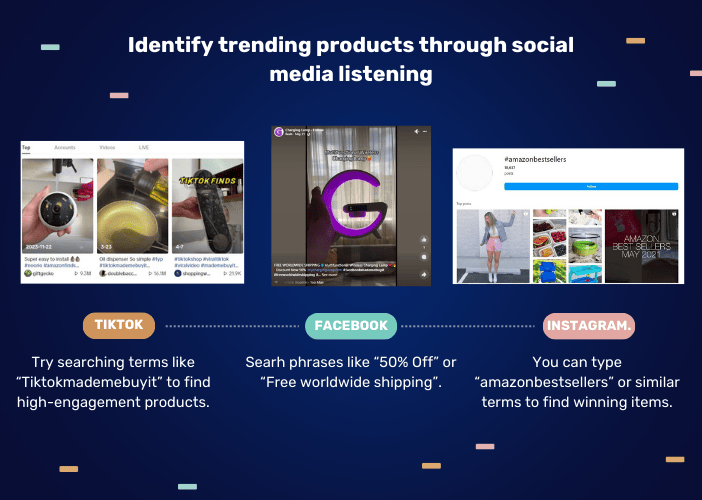
5. Using TikTok Search as a Free Product Research Tool
Search phrases like:
-
“TikTok made me buy it”
-
“Amazon finds”
-
“Must-have gadget”
-
“Life hack product”
Then filter by:
-
Recent posts
-
High engagement
-
Product-focused videos
This reveals what consumers are discovering organically.
6. Comment Section: The Most Underrated Data Source
Comments reveal:
-
Purchase intent (“Where can I buy this?”)
-
Price sensitivity
-
Pain points
-
Objections
-
Alternative use cases
If comments show confusion or skepticism, conversion may be difficult.
7. Tracking Viral Products With Paid Tools (And When to Use Them)
Paid tools can help, but they’re not magic.
They work best for:
-
Pattern recognition
-
Cross-platform validation
-
Scaling decisions
Never rely solely on tools—context matters more than data volume.
8. Separating Short-Term Virality From Real Demand
8.1 Trend vs Utility Products
Ask:
-
Does this solve a repeat problem?
-
Is it seasonal or evergreen?
-
Can it be bundled or upsold?
Products with no repeat use often require constant ad spend.
8.2 The “Post-Viral Drop Test”
Check:
-
Google Trends stability
-
Amazon reviews growth
-
Continued organic posting
This helps determine if demand survives beyond hype.
9. Supplier Reality Check: Can This Product Scale?
Before committing, validate:
-
Production capacity
-
Shipping speed
-
Quality consistency
-
Custom branding options
A viral product with weak supply chains is a liability.

10. Price Band Sweet Spots for Social Media Products
Most social-driven dropshipping products perform best between:
-
$15–$40 retail
This range:
-
Encourages impulse buying
-
Supports paid ads
-
Leaves margin for creatives and logistics
Higher-priced items require stronger branding.
11. Creative Angle Matters More Than the Product
Many sellers fail not because of bad products—but weak creatives.
Winning creatives usually include:
-
Immediate hook (first 2 seconds)
-
Clear use case
-
Before-and-after visuals
-
Real-life context
-
Authentic presentation
Tracking viral products means tracking viral storytelling styles, too.
12. How to Avoid Chasing Dead Trends
Red flags include:
-
Overly polished influencer ads
-
Identical ad scripts everywhere
-
Negative sentiment in comments
-
Heavy discounting already required
If ads feel forced, the trend is likely over.
13. From Trend to Store: Execution Strategy
Decide early:
-
One-product store or general store?
-
Brand-focused or speed-focused?
-
Organic traffic or paid ads?
Your execution model should match the trend’s lifecycle.
14. Scaling Winning Products Without Burning Them Out
To scale responsibly:
-
Rotate creatives frequently
-
Test multiple audiences
-
Introduce bundles or variations
-
Improve product presentation
Overexposure kills even the best products.
15. Building a Repeatable Viral Tracking System
Successful sellers:
-
Monitor platforms daily
-
Save and categorize videos
-
Track engagement metrics manually
-
Validate before launching
Consistency beats luck.
16. The Role of Timing in Dropshipping Success
Being:
-
Too early = unclear demand
-
Too late = heavy competition
The sweet spot is early validation, not first discovery.
17. Ethical Considerations in Viral Product Selling
Avoid products that:
-
Make false claims
-
Target vulnerable groups dishonestly
-
Have safety risks
Short-term profit isn’t worth long-term damage.
18. Turning Viral Products Into Long-Term Brands
The best outcomes happen when:
-
Trends inspire category entry
-
Products lead to brand expansion
-
Customers return for more
Virality can be the door—not the destination.
19. Common Mistakes New Dropshippers Make
-
Blindly copying competitors
-
Ignoring customer feedback
-
Over-ordering inventory
-
Relying on one platform only
A diversified approach is safer.
20. The Future of Social Media Product Discovery
Trends are moving toward:
-
Shorter lifecycles
-
Faster saturation
-
Higher creative standards
The winners will be those who analyze faster, test smarter, and execute cleaner.
Conclusion: Viral Products Are Signals, Not Guarantees
Social media doesn’t hand out guaranteed winners—it offers signals.
Successful dropshippers don’t chase every viral product.
They evaluate, filter, validate, and act with discipline.
By mastering social media trend tracking, you move from guessing to strategic product selection—and that’s the real competitive advantage in modern dropshipping.
In a crowded market, speed matters.
But clarity matters more.