

















< Blogs

3PL vs 4PL: Which Logistics Solution is Right for Your Business?

Vivan Z.
Created on December 14, 2024 – Last updated on February 6, 20257 min read
Written by: Vivan Z.

3vs4

Ever wondered, “What is a 3PL? What is a 4PL?” These terms might sound like jargon, but understanding them is essential for businesses aiming to optimize logistics and supply chain management. Whether you’re a small e-commerce seller or a global manufacturer, the right logistics partner can make or break your operations. Let’s dive into what 3PL and 4PL mean, their differences, and how to choose the best solution for your business.

What Is a 3PL?

A 3PL (Third-Party Logistics) provider is a company that handles specific logistics functions for your business. Think of it as outsourcing transportation, warehousing, or distribution tasks to a specialist.
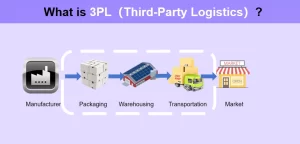
What is 3PL 4

For example, if you run an e-commerce store, a 3PL can store your products in their warehouse, pick and pack orders, and ship them to your customers. Their expertise and infrastructure streamline logistics, allowing you to focus on growing your business.

Now, imagine a small business selling home decor online. Partnering with a 3PL means their products are stored in a central warehouse. When a customer places an order, the 3PL picks, packs, and ships it. The result? Faster deliveries and happier customers without the hassle of managing inventory and shipping.

What Is a 4PL?

A 4PL (Fourth-Party Logistics) provider takes logistics management to the next level. Unlike a 3PL, which focuses on execution, a 4PL acts as a strategic partner overseeing your entire supply chain.
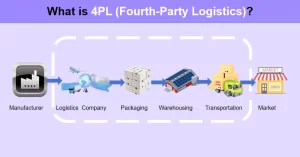
What is 4PL

Unlike 3PL, which primarily provides businesses with tangible and specific logistics operations, 4PL acts more like a “commander,” leveraging extensive logistics management experience, information technology, and available resources to deliver optimized and integrated supply chain solutions, ultimately reducing business costs.

4PLs integrate multiple 3PLs, manage vendors, and provide end-to-end visibility. They ensure that every aspect of the supply chain—sourcing, transportation, warehousing, and distribution—is optimized and aligned with your business goals.

Let’s say you’re a global electronics brand sourcing components from Asia, manufacturing in Europe, and distributing to North America. A 4PL coordinates multiple 3PLs across these regions, ensuring raw materials arrive on time, production schedules stay on track, and finished products reach customers efficiently.

By providing centralized oversight and advanced analytics, a 4PL helps reduce costs, mitigate risks, and improve supply chain agility.

Difference Between 3PL and 4PL

While both 3PL and 4PL aim to streamline logistics and improve supply chain efficiency, they differ significantly in their scope, responsibilities, and level of involvement in your business. 3PL focuses on executing specific logistics tasks, while 4PL takes on the broader responsibility of managing and optimizing the entire supply chain, offering more comprehensive strategic support and technology integration.

The following table highlights the key differences between 3PL and 4PL in terms of roles, responsibilities, technology, cost helping you understand which solution might be the best fit for your needs.
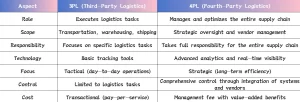
3PL and 4PL in terms of roles

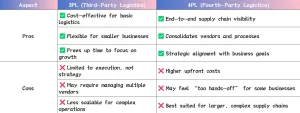
The following table outlines the pros and cons of 3PL and 4PL to help you understand the benefits and potential drawbacks of each option.

3PL vs 4PL

Key Takeaways:

1.If you need support with specific logistics tasks like transportation or warehousing, go for a 3PL.

2.If you require full supply chain management and strategic oversight, a 4PL is the better choice.

3.As your business grows and logistics complexity increases, you may start with a 3PL and transition to a 4PL for enhanced coordination and efficiency.

Choosing the Right Solution for Your Business

Choosing between 3PL and 4PL is not a one-size-fits-all decision. The best option depends on the specific needs of your business, including its size, complexity, and long-term goals. Let’s break this down to help you make the right choice:


1. Business Size and Scale

•  Small Businesses and Startups:
If you’re just starting out or running a small operation, a 3PL provider might be your ideal choice. It offers exactly what you need: transportation, warehousing, and shipping services. You won’t have to invest heavily in logistics infrastructure, and you can focus on growing your business while leaving the execution to experts.

•  Medium to Large Businesses:
As your business grows and your supply chain becomes more complex, a 4PL might be the better fit. A 4PL takes on a strategic role, coordinating multiple 3PLs, optimizing processes, and managing vendors. This allows your team to focus on core operations while the 4PL ensures your entire supply chain runs smoothly.


2. Operational Complexity

•  Low Complexity Operations:
If your logistics requirements are straightforward, such as shipping from a single warehouse to customers, a 3PL is sufficient. They’ll handle the daily operations efficiently, ensuring orders are fulfilled on time.

• High Complexity Operations:
For businesses with multi-region supply chains, cross-border shipping, or high variability in demand, a 4PL is essential. They can streamline processes, use data analytics for decision-making, and ensure you stay competitive in a global market.


3. Long-Term Business Goals

•  Short-Term Cost Control:
A 3PL is ideal for businesses prioritizing cost efficiency in the short term. By outsourcing warehousing and transportation, you eliminate upfront investment in infrastructure while still meeting customer expectations.

•  Strategic Growth and Optimization:
If you’re aiming for long-term growth, a 4PL helps align your logistics strategy with your business objectives. They provide end-to-end visibility, optimize the supply chain, and implement scalable solutions that grow with your business.


4. Cost vs. Value

•  3PL Costs:
A 3PL typically charges for specific services like storage, shipping, and handling. While these costs are straightforward, you may need to manage additional logistics vendors if your business grows.

•  4PL Costs:
A 4PL might seem more expensive upfront due to their broader responsibilities. However, they bring added value by reducing inefficiencies, consolidating vendors, and leveraging technology for cost savings over time.

The following table summarizes key factors to consider when choosing between 3PL and 4PL based on business size, operational complexity, focus area, and cost considerations.
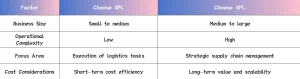
choose 3PL or 4PL

Transition to DropSure: Simplify Your Logistics

Still feeling overwhelmed by logistics? Imagine having a partner that not only handles fulfillment but also optimizes your entire supply chain. That’s where DropSure comes in.

DropSure offers a seamless solution for businesses, combining efficient dropshipping services with advanced logistics management. Whether you need a reliable 3PL or the strategic insights of a 4PL, DropSure has you covered.

Why Choose DropSure?

• Simplified operations with integrated tools

• Faster delivery with a global network of partners

• Transparent pricing to reduce costs

Ready to streamline your logistics? Sign up for DropSure today and experience smarter supply chain solutions tailored to your business needs.


Buttom

DropSure is Your Best Partner
22 Years Experience
Affiliate Rebates
100% Quality Guarantee
Top-Up Rewards
10+ Global Warehouses
Custom Branding Support
Smart inventory System
24/7 Customer Support
Get a Quote in 24 Hours
Start Sourcing for Free

Keep Learning

With an 8.5% year-on-year growth, Japan’s e-commerce sector is projected to break through ¥152 trillion in 2024, continuing its dominance as the fastest-growing mature market in Asia. This nation of 120 million high-net-worth consumers is driving unprecedented momentum, fueled by a 94% mobile payment adoption rate and a 28% cross-border e-commerce growth rate—making it a strategic growth engine for global brands. Are you planning to enter the Japanese market, or seeking to understand the platforms Japanese consumers trust most? Mastering the local e-commerce landscape is the first step to success. From generalist platforms to niche verticals, Japan’s ecosystem offers unique opportunities. This article will analyze the top 6 mainstream e-commerce platforms in Japan, helping you decode market trends and seize growth potential. Amazon Japan  ​Platform Website:https://www.amazon.co.jp  Amazon Japan holds a significant position in Japan’s e-commerce market, with an estimated monthly visit count of approximately 601.7 million, highlighting its popularity and substantial market influence. Founded in 1994 by Jeff Bezos in Bellevue, Washington, Amazon began as an online bookstore. Over time, it transformed into a comprehensive shopping platform where consumers can easily purchase a wide variety of products, including books, clothing, food, electronics, and streaming services.  Seller Fee Structure For every transaction that a seller completes, Amazon charges a fee based on a fixed percentage. The sales commission percentage varies depending on the product category. For example, the commission for fashion items may range from 8% to 15%, while consumer electronics typically range between 8% and 15%. If a seller utilizes Amazon’s FBA (Fulfillment by Amazon) service, additional fees will apply. These include storage fees, which are charged for storing products in Amazon’s warehouses and are calculated based on the time period as well as […]

A while ago, my mom suddenly asked me, “Can you make one of those websites where you sell stuff online?”I replied, “Do you mean like Taobao or Pinduoduo? Or the kind where you don’t keep inventory?”She said, “The kind without inventory—I don’t have space to store stuff.” Alright, that made things clear: she wanted to do dropshipping. So, I slapped my thigh and decided to help her set up her own independent store—not a little shop on Pinduoduo or Amazon, but a website she could truly call her own. Step 1: Define the Product Category Before diving into product selection, I did a simple yet practical market research with her to make sure we weren’t blindly listing products but making decisions based on data and trends. We mainly referred to the following platforms and dimensions: Google Trends  This was the first tool we checked to confirm the popularity trends of a product category globally or within our target market. We didn’t just look at recent trend curves but also pulled data from the past five years to see whether the category was a seasonal spike or a stable, long-term growth niche. For example, some holiday-related products peak once a year but miss the timing and fail completely; while categories like fitness or pet supplies have steady trends and are better for long-term operation. TikTok & Instagram These two platforms helped us capture real-time consumer interests and hot topics. On TikTok, we focused on viral videos’ likes, genuine feedback in the comments, and influencer recommendations on how to use the product. Instagram was more lifestyle-oriented; we searched keywords to see what people were sharing and recommending, and also got a glimpse […]

In the early days of dropshipping, success often came from chasing what was popular. If a product went viral, thousands of sellers rushed in. Margins were high, competition was low, and speed mattered more than strategy. That era is over. Today’s dropshipping landscape is crowded, competitive, and algorithm-driven. Selling the same trending products as everyone else no longer guarantees profit—in fact, it often guarantees failure. Rising ad costs, price wars, and consumer fatigue have made “hot products” increasingly difficult to scale. This is why a growing number of successful sellers are shifting their focus toward underrated, low-competition niches. These so-called “boring” or overlooked categories are quietly becoming the most reliable way to build sustainable dropshipping businesses. In this article, we’ll explore a new product selection mindset—one that prioritizes niche depth over mass appeal, data-backed demand over hype, and long-term positioning over short-term wins. 1. Why Traditional Dropshipping Product Selection Is Failing 1.1 The Saturation Problem Scroll through TikTok, YouTube, or Instagram, and you’ll see the same products repeated over and over: Viral gadgets “Problem-solving” kitchen tools Beauty devices with dramatic demos By the time these products reach mainstream attention: Hundreds of stores are already selling them Ad creatives look identical Consumers have seen them too many times Saturation doesn’t just reduce profit—it destroys trust. 1.2 Rising Costs and Shrinking Margins Popular niches attract: Aggressive ad bidding Copycat competitors Price undercutting As a result: Customer acquisition costs increase Average order value stagnates Profit margins collapse Many sellers mistakenly believe the problem is marketing, when in reality, the issue lies in product selection. 2. What Does “Underrated Niche” Really Mean? 2.1 Underrated Does Not Mean No Demand An underrated niche is not […]

Recommended for you

Outsunny 13 x 13 Replacement Mesh Sidewall Netting for Patio Gazebos and Canopy Tents with Zippers Sidewall Only Cream
$ 61.41
Taupe Reclining Chair 1pc Comfort Seating Faux Leather Upholstery Living Room Furniture Solid Wood
$ 257.25
Transparent lace sexy slimline bra set Bra Breathable back underwear
$ 4.59
Double-ended Spray Fan Portable Humidifier Fan Air Conditioner Household Small Air Cooler Hydrocooling Portable Air Adjustment
$ 6.18
China-Chic Meilong New Solid Brass Mosquito Incense Tray Incense Stove Antique Antique Antique Bronze Crafts Collection Ornaments
$ 2.85
Ferris wheel rotating glass spice rack set seasoning bottle seasoning jar spice jar seasoning bottle with bottle 18 jars
$ 5.82
Kemei Multifunctional Electric Hair Brush Hair Dryer Ion- Straightening Curling Iron Blower Comb Hot Air Styling Salon Tool
$ 16.76
Genuine Marble Top End Table Dark Cherry Finish Wood Frame Contemporary Living Room Furniture 1pc Side Table
$ 168.00
Western Grove Coffee Table
$ 80.84
8640E Louver Pergola 10x19ft aluminum frame & steel louvers
$ 409.50
【 Hot selling classic 】 Single board skiing gloves braised waterproof and anti slip touch screen five finger skiing gloves
$ 6.71
21seat widthlarge size Electric Power Lift Recliner Chair Sofa for Elderly 8 point vibration Massage and lumber heat Remote Control Side Pockets and Cup Holders cozy fabric overstuffed arm pu
$ 314.99
Medieval enamel oil painting light luxury retro earrings
$ 3.18
Winter loose and lazy style thick sweater cardigan top European and American style fashionable and personalized patchwork denim jacket womens trend
$ 11.82
Refrigerator transparent film fresh-keeping box lemon avocado tomato fruit portable sealed box for work anti oxidation
$ 0.62
Simulated tree simulated green plant potted plant indoor large plant decoration fake tree ornament
$ 29.55