


















< Blogs

What are VAT, OSS, and IOSS? 2025 Global E-Commerce Guidance

Vivan Z.
Created on December 3, 2024 – Last updated on February 6, 20258 min read
Written by: Vivan Z.

As global e-commerce continues to expand, staying compliant with local tax regulations is becoming increasingly essential for businesses. Among the most important tax systems that affect cross-border sales in the European Union are VAT, OSS, and IOSS. These systems not only ensure compliance but also help businesses streamline their operations and avoid costly mistakes.

In this article, we will break down what VAT, OSS, and IOSS are, how they work, and how understanding these frameworks can help you stay ahead in the global e-commerce game as we approach 2025.


Here’s an table with Standard VAT Rate for some important countries: 
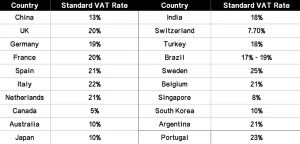
 

country & VAT

Note: The United States does not have VAT; it only has sales tax. Sales tax is levied only at the retail stage, unlike in most countries where taxes are applied to the value added at each stage of the supply chain.


What is VAT ?


VAT 2

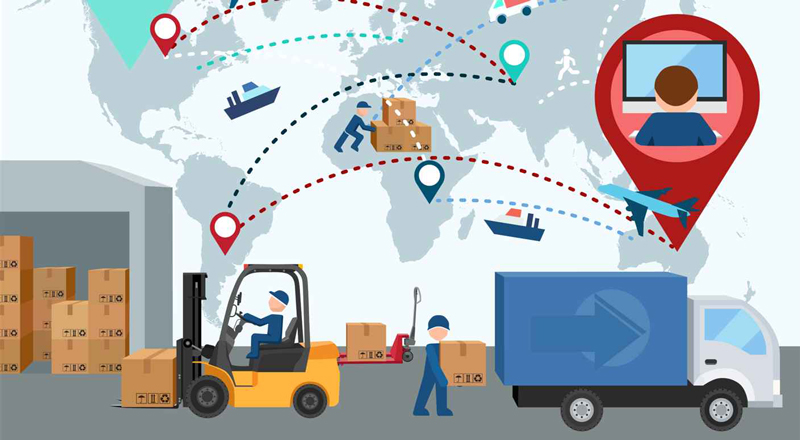
VAT is charged at each stage of the supply chain, including production, wholesale, and retail. At every stage, tax is applied to the “added value” of goods and services. The “added value” refers to the extra value created at each stage, like processing, transforming, transporting, and distributing the product.

Example: Let’s say you’re a toy factory. You make a toy and sell it to a store. The store then sells it to a customer. At each step, from production to sale, a small tax is added. But each person only pays VAT on the “added value” they created, not the entire product.


Let’s walk through the process:
Assume you buy a television at an electronics store, priced at 500 euros. The VAT rate is 20%.

1.Merchant Purchase (Wholesaler)
The merchant purchases the television from a supplier at a price of 300 euros (excluding VAT).
The VAT paid on the purchase is 300 euros * 20% = 60 euros.
Therefore, the merchant actually pays the supplier a total of 300 euros + 60 euros = 360 euros.


2.Merchant Sale (Retailer)
The merchant then sells the television to you for 500 euros (excluding VAT).
The VAT charged to you is 500 euros * 20% = 100 euros.
So, you pay the merchant a total of 500 euros + 100 euros = 600 euros.


3.Merchant’s Tax Handling
The merchant collects 100 euros in VAT from you, but he already paid 60 euros in VAT when purchasing the television.
Therefore, the merchant needs to pay the tax authorities 100 euros – 60 euros = 40 euros.
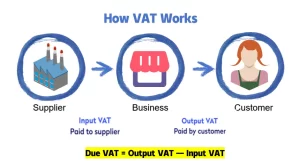
 

How VAT Works 2


Summary of VAT Calculation Formulas:

● VAT (at each stage) = Sales Price × Tax Rate

● Total Sales Price = Sales Price + VAT

● Actual Payment Price = Sales Price + VAT – Already Paid VAT (deducted)

These formulas simplify the calculation of VAT at each step in the supply chain, ensuring clarity in how VAT is applied and deducted.


Who Should Use VAT?


 VAT-Registered Businesses
In most countries, if you are a legally operating business and your annual sales exceed a certain threshold, you must register and use VAT.
This applies to companies that provide goods or services, such as manufacturers, retailers, wholesalers, and service providers.


Consumers
The end consumer is the “actual payer” of VAT. While businesses collect VAT, the cost is ultimately included in the price of goods or services and borne by the consumer.


What is OSS?


The EU introduced a simplified VAT filing and payment system called the “One-Stop-Shop” (OSS). With OSS, you only need to register for VAT in one EU country, rather than registering separately in each country where you sell.


For example, if your company is already VAT-registered in Germany, you can use the OSS system to file and pay VAT for all your cross-border sales in France, Italy, and Spain through the German tax authorities. This means you don’t need to register and submit VAT returns in each country; all VAT payments are handled through Germany’s tax office.


How does OSS work? 


1.Registration: Businesses need to register for OSS with the tax authorities of an EU member state. EU businesses can choose to register in their home country, while non-EU businesses must register in one EU member state. After registration, you will receive an OSS VAT number.


2.VAT Collection: Even though VAT is declared through the OSS system, you still need to charge VAT based on the rates of each EU country where you sell. For example, when selling goods in France, Germany, or Italy, you must charge VAT according to the local VAT rate of each country.


3.VAT Declaration and Payment: Every quarter, businesses need to submit a VAT return electronically, listing the sales and VAT collected for each EU country. You will then pay the total VAT in one place. The tax authorities will forward the payments to the relevant countries.


Example: Suppose you sold two items—one to France and one to Germany:

For the sale to France, you would charge French VAT at the applicable rate.

For the sale to Germany, you would charge German VAT at the applicable rate.

After collecting these VAT amounts, you submit a single VAT return through the OSS system, and pay the total VAT. The payments will be distributed to the French and German tax authorities accordingly.


Example Calculation for OSS:

● Sale to France:

Sale amount: 100 EUR

VAT (20%): 100 × 20% = 20 EUR

Sale to Germany:

Sale amount: 100 EUR

VAT (19%): 100 × 19% = 19 EUR

You will submit this information on the OSS platform and pay
the total VAT:
20 EUR + 19 EUR = 39 EUR.

The OSS system will then distribute the VAT payments to the tax authorities of France and Germany accordingly.


What is IOSS?


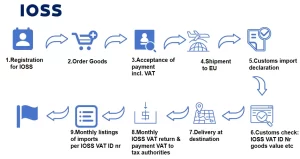
IOSS (Import One-Stop Shop) is a new policy introduced by the EU to simplify VAT (Value Added Tax) declaration and payment for cross-border e-commerce imports. It allows merchants to pay VAT directly to the EU tax authorities when goods are imported, instead of requiring consumers to pay VAT upon receipt of the goods.
 

IOSS 3


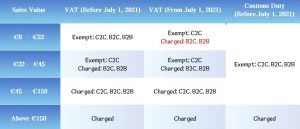
IOSS applies only to low-value goods, meaning items priced below 150 euros each.

For example, if you sell an item for 120 euros (excluding VAT), using the IOSS system, you can pay VAT to the tax authorities when the goods enter the EU. The consumer does not need to pay any additional VAT when receiving the item.
 

VAT IOSS OSS


How does IOSS work?


1.Merchant Registers for IOSS: The merchant registers for IOSS in an EU member state and obtains an IOSS number.


2.VAT Calculation at the Time of Sale: The merchant calculates and collects VAT based on the consumer’s country of residence (for example, a 100-euro product sold in France with a 20% VAT would have 20 euros in VAT).


3.Merchant Pays VAT: The merchant pays the collected VAT to the EU tax authorities through the IOSS system.


4.VAT Exemption Upon Import: When the goods enter the EU, the VAT already paid is considered settled, and the consumer does not need to pay VAT at customs.


5.Unified Reporting: The merchant submits a single VAT report through the IOSS system, eliminating the need for separate declarations in each EU country.


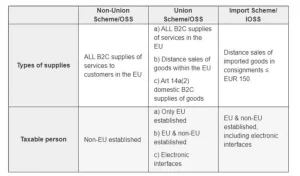
The differences between OSS and IOSS

Here’s a table summarizing the differences between OSS (One-Stop Shop) and IOSS (Import One-Stop Shop) in the context of the EU VAT system:
 

OSS &IOSS difference


As we move toward 2025, being well-versed in these tax systems will position your business to thrive in the competitive world of cross-border e-commerce. Make sure to stay informed, adapt your strategies, and leverage these systems to remain at the forefront of global e-commerce.

Buttom


DropSure is Your Best Partner
22 Years Experience
Affiliate Rebates
100% Quality Guarantee
Top-Up Rewards
10+ Global Warehouses
Custom Branding Support
Smart inventory System
24/7 Customer Support
Get a Quote in 24 Hours
Start Sourcing for Free

Keep Learning

Ever wondered, “What is a 3PL? What is a 4PL?” These terms might sound like jargon, but understanding them is essential for businesses aiming to optimize logistics and supply chain management. Whether you’re a small e-commerce seller or a global manufacturer, the right logistics partner can make or break your operations. Let’s dive into what 3PL and 4PL mean, their differences, and how to choose the best solution for your business. What Is a 3PL? A 3PL (Third-Party Logistics) provider is a company that handles specific logistics functions for your business. Think of it as outsourcing transportation, warehousing, or distribution tasks to a specialist. For example, if you run an e-commerce store, a 3PL can store your products in their warehouse, pick and pack orders, and ship them to your customers. Their expertise and infrastructure streamline logistics, allowing you to focus on growing your business. Now, imagine a small business selling home decor online. Partnering with a 3PL means their products are stored in a central warehouse. When a customer places an order, the 3PL picks, packs, and ships it. The result? Faster deliveries and happier customers without the hassle of managing inventory and shipping. What Is a 4PL? A 4PL (Fourth-Party Logistics) provider takes logistics management to the next level. Unlike a 3PL, which focuses on execution, a 4PL acts as a strategic partner overseeing your entire supply chain. Unlike 3PL, which primarily provides businesses with tangible and specific logistics operations, 4PL acts more like a “commander,” leveraging extensive logistics management experience, information technology, and available resources to deliver optimized and integrated supply chain solutions, ultimately reducing business costs. 4PLs integrate multiple 3PLs, manage vendors, and provide end-to-end visibility. […]

Dropshipping has become popular in recent years. It has low entry barriers and does not require inventory. This makes it a great option for new sellers. However, expanding your business into international markets often brings complex tax policies that can be a headache. Without understanding these in advance, your profit margins may suffer, and you could even face compliance risks. Today, we will talk about tax issues for dropshipping sellers. We will focus on important markets like the U.S., EU, Australia, and Canada. United States: Sales Tax Varies by State   In the U.S., sales tax can be quite complicated since each state has its own regulations. In simple terms, if your dropshipping business creates an “economic nexus” in a state, you must collect sales tax. This happens when you meet a specific sales threshold in that state. Tax rates can be very different. For example, California has an average sales tax of 7.25%. In contrast, Oregon has no sales tax at all. It is important for dropshipping sellers to know where they have an economic nexus. They should also check the tax rates in those states. Sales tax rates in the U.S. can vary a lot. Some rates are close to 10%. However, some states do not collect sales tax at all. For dropshipping sellers, setting the right prices according to state tax rates is essential to ensure profitability. European Union: Uniform Rules for Value-Added Tax (VAT)     Compared to the U.S., the EU has a more unified tax policy. All sellers who sell goods within the EU must pay Value-Added Tax (VAT), regardless of their location. However, each country’s VAT rate varies, such as 19% in Germany […]

In today’s fiercely competitive cross-border e-commerce landscape, advertising costs are soaring, and acquiring new customers is becoming increasingly expensive. If you’re a dropshipping seller looking to boost profits without blindly increasing your ad budget, then increasing your Average Order Value (AOV) is one of the most worthwhile optimization strategies you can invest in. This blog will break down in detail:● What AOV is and why it’s critical for profitability● 6 practical strategies to increase AOV● Tool recommendations and real case studies● Data references and actionable tips What is AOV?  AOV stands for Average Order Value. It refers to the average revenue generated from each customer order and is a key metric for evaluating your store’s profitability. The formula is quite simple:Total revenue during a given period ÷ Total number of orders = AOV For example, if your store made $10,000 in revenue this month from 200 orders, your AOV would be:$10,000 ÷ 200 = $50 That means, on average, each order brought in $50 of revenue. Why Increasing AOV Is Essential for Your Business  Increasing AOV is not just a fancy trick — it’s a key metric in e-commerce operations that directly impacts profit, efficiency, and sustainable growth. Here are four core reasons why you should focus on boosting your AOV right now. Increase Profit Without Raising Order Volume  First, increasing AOV means you can boost overall profit without needing to increase the number of orders. You don’t have to rely on “fake orders” or price wars to push volume — simply getting customers to buy a bit more each time will expand your profit margin. This is especially practical and direct leverage for sellers with inventory pressure or limited […]

Recommended for you

Pearl Thong Sandals Summer Fashion T-Strap Flat Sandals With Elastic Band Beach Shoes For Women
$ 3.18
West Month Eye Cream Moisturizing And Moisturizing Skin Around The Eyes To Reduce Fine Lines Gentle Repair Massage Eye Cream
$ 8.39
Stainless Steel Kitchen Roll Paper Towel Holder Bathroom Tissue Stand Dining Table Vertical Napkins Rack Kitchen Storage Shelf
$ 1.41
Cute Penguin Hand Warmer For Office And Travel Carrying. Heat Up Quickly And Maintain A Constant Temperature To Keep Warm
$ 5.29
14.8 Ft Double Sided Outdoor Umbrella Rectangular Large with Crank Light green No Base
$ 39.90
Metal butterfly flower earrings light luxury high sense of niche design temperament simple
$ 0.79
Spring and autumn new solid color long sleeve lapel suit small coat for women
$ 6.35
Prohibited From Sale On Amazon XISHAN Black Weed Control Fabric 90g HDPE
$ 37.60
EELHOE Sheep Placenta Collagen Essence Moisturizes Anti-Wrinkle Lightens Skin Melanin Moisturizes And Brightens
$ 10.49
Four in one super fast charging mobile data cable
$ 0.82
Shell pearl zircon Korean version diamond-inset fashion anti-fading light luxury temperament titanium steel necklace
$ 1.51
Corner Table Sharon Living Room White
$ 91.34
Magnet myopia night vision ski goggles
$ 12.18
Casual Sweet Loose V-neck Printed Hanging Beard Middle Sleeve Long Dress for Women
$ 6.18
Jiate DIY Cottage SL07 Detective Famous Society 3D Book Stand Model Handmade Assembly Creative Birthday Gift Ornament
$ 19.59
Magic Water Genie toy Water Baby Magic Ocean kids 5 girls enthrallingly diy handmade puzzle for boys
$ 0.64